Summary
Umbraco AI

Umbraco AI
The world of content management is evolving rapidly, and AI is at the forefront of this transformation. Umbraco, a widely used .NET CMS, presents exciting opportunities for AI integration to enhance automation, content generation, and user experience. I recently sat down with some of our Umbraco developers and we discussed different ideas for AI inside Umbraco:
One of the key areas where AI can contribute is in content creation and optimization. AI models can assist with generating articles, product descriptions, and even suggesting SEO-friendly metadata.
Content Scoring & Recommendations: AI can analyze content within Umbraco and provide a "quality score" based on readability, SEO, and engagement potential.
Automated Metadata Generation: AI can suggest appropriate meta descriptions, keywords, and titles to improve discoverability.
Voice search is becoming increasingly relevant, and integrating speech-to-text functionality into Umbraco’s search features could greatly improve accessibility.
AI-powered speech recognition can allow users to conduct searches or add content through voice commands.
AI-driven chatbots or virtual assistants could guide users within Umbraco’s back office, making navigation and task execution smoother.
Many companies operate in multiple languages, and AI can streamline content translation.
AI-powered translation tools can provide multilingual content suggestions directly within Umbraco.
Language detection can help ensure accuracy and consistency across different regions.
One of the challenges organizations face is upgrading from older versions of Umbraco to newer ones. AI could assist in this by:
Analyzing an existing Umbraco installation and its dependencies.
Identifying outdated packages and suggesting replacements.
Predicting potential migration challenges and offering solutions.
AI can help streamline workflows inside Umbraco by automating repetitive tasks:
Automatically tagging media assets based on image recognition.
Enhancing form validation and spam filtering.
Suggesting layouts and content improvements based on past performance.
While AI integration in Umbraco is still in its early stages, these ideas showcase the potential for making the CMS more intelligent and efficient. At Phases we are actively working on some of the above ideas.
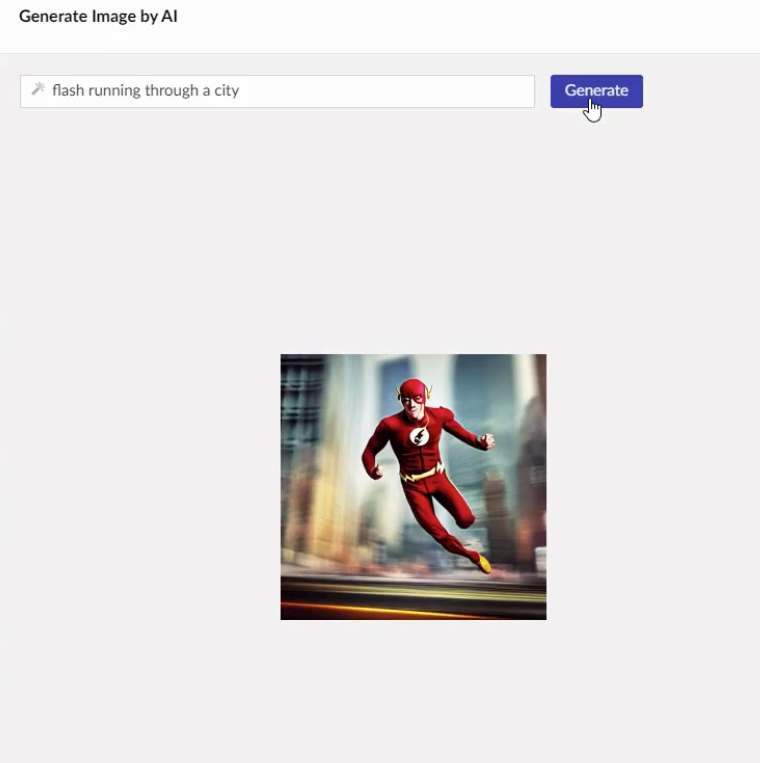
Beyond theoretical ideas, there are already practical implementations of AI within Umbraco. One such example is a custom plugin developed by Afreed CP, which enables AI-generated media assets inside Umbraco’s media library.
The plugin allows users to generate AI images directly inside Umbraco using a simple text prompt. Instead of manually uploading media files, content creators can describe the image they need, and AI generates it within seconds. This integration provides a seamless way to enhance content workflows.
AI Model: The system utilizes an in-house AI model trained for image generation.
Backend Processing: A Python-based API interacts with Umbraco to fetch the prompt, generate the image, and store it in the media section.
Umbraco Integration: The AI functionality is embedded as a custom property within Umbraco’s media picker, allowing users to generate or select existing media.
Enhancing image customization with style filters and aspect ratio adjustments.
Integrating third-party AI APIs for more diverse media generation capabilities.
Expanding beyond images to AI-generated video and animations.
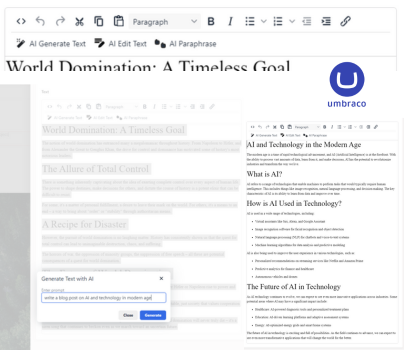
In addition to AI-powered media generation, Afreed and the Phases team are also working on AI-powered text tools within Umbraco’s rich text editor. These tools allow users to:
Generate text based on context.
Paraphrase existing content.
Receive AI-driven content suggestions in real-time.
Published 26 February 2025 by Afreed CP, Daniel Horn and Dhanesh Kumar MJ. Part 1 outlines possible AI directions for Umbraco. Part 2 describes an implemented Phases media-generation plugin (in-house image model, Python API, Umbraco media picker and media-library storage). Treat Part 1 ideas as proposals unless the article marks them as built.